Plenty of work for groundsman John Fletcher
The cricket season may just be begining and the oval at Masterton’s Queen Elizabeth II park won’t see any action for a week or two yet, but for head groundsman John Fletcher the preparation has been underway for months. In fact work on preparing the block began almost immediately after the previous playing season was over.
“Our first job was to scarify the surface of the block which is basically a machine the rips up the grass and a little bit of the clay. Then we put new grass seed down and fresh clay on top of that. Then right through winter we’re basically just mowing and keeping the maintenance up, and now that it’s Spring we can begin the real preparations ready for the Summer season.”
For those who don’t diligently follow cricket, the block is the area in the middle of the ground that the individual pitches are placed. At the Masterton oval, the block is approximately thirty by twenty metres and has six pitches. Each of those is 25 metres long and three metres wide - although it is exactly 20.12 metres (which is 22 yards) between the stumps. The block is composed of clay, approximately 200mm deep, although that varies as each year a little at the top is dug up and replaced. Every twenty years or so the whole block is dug up and all the clay is replaced and then thoroughly compressed with a roller so that it’s really hard.

Once the weather warms up, John is able to begin fertilising, putting down the measurements for each pitch, and can start mowing each one in a different direction. At the moment he has set the mower to a height of exactly 23 millimetres but will reduce that to twelve or even seven millimetres once the season starts. He will also keep watching to see if the ground needs any water, and will fertilise once a month.
During the playing season John will choose a pitch to prepare for the week. “I’ll roll that for ten hours, so a couple of hours each day. In the first two days of rolling you’re going really, really slow. As slow as it can go - it takes seven minutes to do one 30 metre strip. You can go faster as the week gets through because you’ve got the compaction in there already. You are just basically killing the grass off.”
“And so when you see a pitch like now, it's nice and green. When you roll it, and roll it, and roll again, it’s breaking the top leaves off and that's what's making the grass go brown. That’s what you want. This is obviously far too green at the moment.”
Things get a little more involved and busy during the season. John receives an umpires’ report after every match which tells him if there any problems or whether they thought the pitch was too fast or too slow or if they’d like to see a little more or less grass on it, “so that gives me a few things that I’ll work on during the week.” He will get to the ground around 7am for a big match (for example a representative game) run the mower over the pitch, and unless it was done the day before he’ll also run the bigger mower around the outfield. “It’s amazing how much grass grows on there.”
John has carefully measured the position of all six pitches and placed small nylon feathers at the edge of the block so that he can easily and accurately mark the wicket that will be used. “So I run a string line from those (the nylon feathers) and I also use a frame so that all the measurements are accurate and square.” On game day he needs to mark out the lines for the stumps and the creases etc and once that’s all done he will meet with the umpires to discuss if anything else needs to be done before he officially hands the pitch over to them. The umpires are responsible for placing the stumps into the ground.
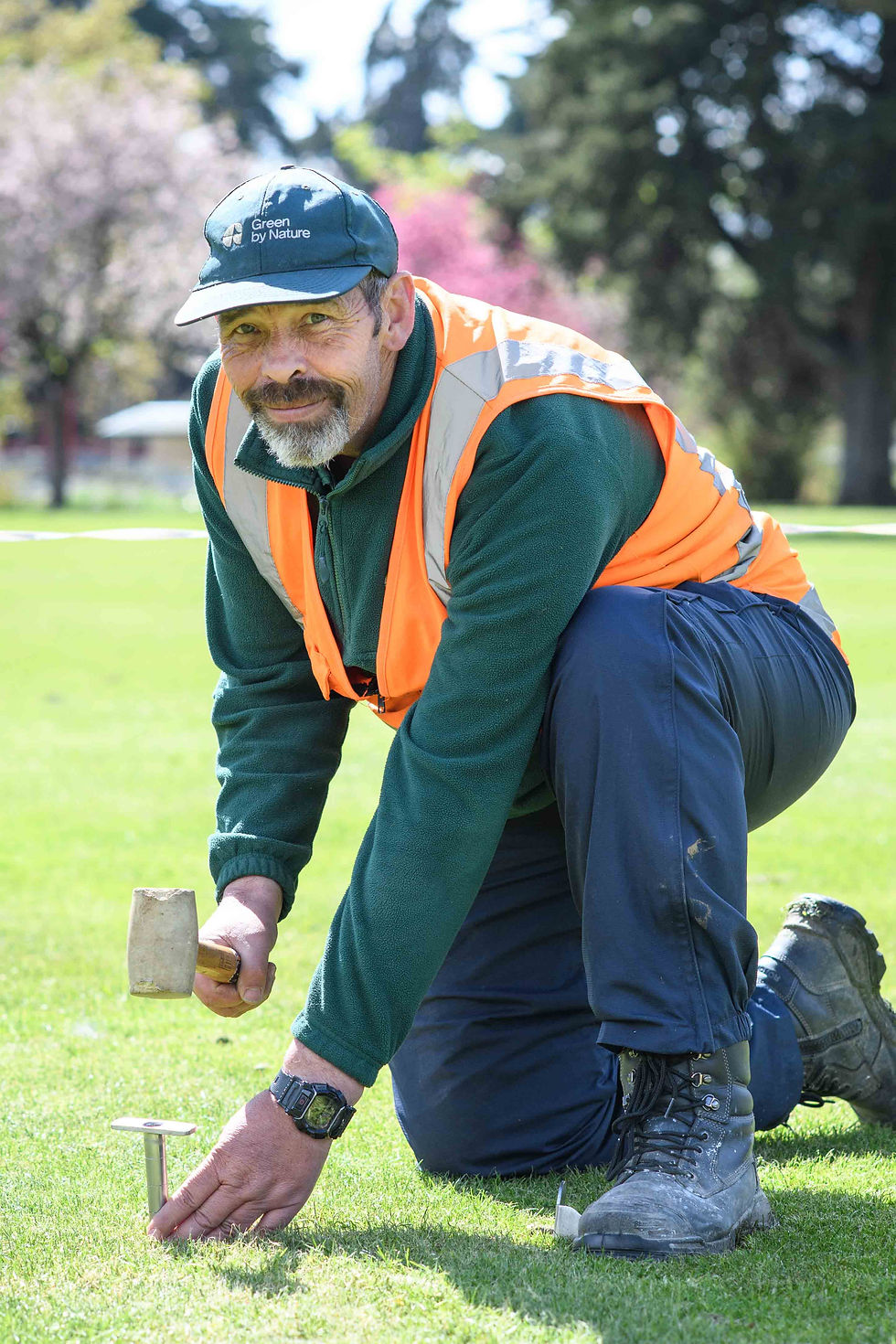
The groundsman is required to be at the ground during those important games but John is restricted what he can do once the pitch has been handed over and the game begins. “I’m only allowed on the pitch in a lunch or tea break to do a little work such as repainting the markings and perhaps use a rubber mallet to tap down a divot. I’m not allowed to remove anything off the pitch. Even if the players want something filled, I can’t just do that. I need to sort it with the umpire. If they say, hey this is a bit dangerous then I’m allowed to do something about it.”
The contract for looking after the grounds is held by Green By Nature. John was working for them and applied for the groundsman job when it came up about five years ago. He needed to obtain his green keeper certificate. “It was like an apprenticeship for like 18 months I think. I got some polytechnic training and spent time with one of the groundsmen at the Turf Institute in Palmerston North. There were also some block courses, then I passed and got my diploma, so yes, I’m basically an official green keeper.” John is responsible for looking after all of Masterton’s sports grounds which include the Park Sports and Pioneer grounds, Memorial Park (Marist) ground, South Park and Douglas Park. However John admits that the oval is his baby. “My primary responsibility would be this pitch so this takes up most of my time.”
It’s obvious that John thoroughly enjoys his job, but does he like cricket? “I do like cricket. I never played but I do like it. I used to watch it on TV all the time. I’m not so fussed on the five day games; I really enjoy the T20s and one-day matches are OK too.”
The first game on the oval for the 2026/27 season won’t be decided for a few more days as Wairarapa Cricket officials need to make sure it is in top condition for a hectic representative cricket schedule in November and early December. It’s most likely to see action in a Coastal Challenge or perhaps a local senior game in late October or early November.
